
Evolution
From DWH 1.0 to 2.0
Nothing breaks. Everything improves.
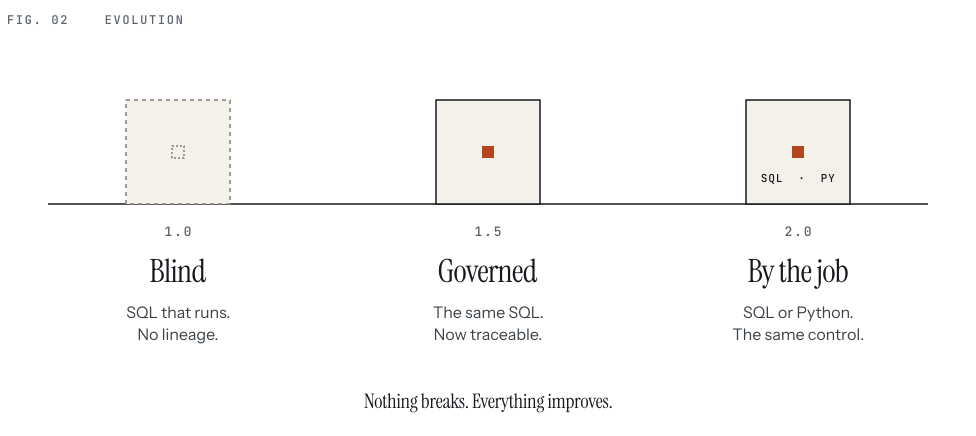
Three versions of the same warehouse
1.0
SQL that runs. Blind.
Where you are now. The procedures run and the figures come out. But nobody can quickly see where a figure comes from or what a change touches.
1.5
The same SQL, now traceable.
The existing procedures get templates around them. That makes them traceable, testable and auditable. The SQL itself does not change.
2.0
The best tool per job.
SQL where SQL works best, Python where that fits better. Under the same control as in 1.5.
Code is solved
AI writes the code. The bottleneck has moved to what comes after: reviewing, testing and proving it is right.
A new platform does not fix that. Every tool choice still needs custom work, as much as the last one. So the question is not which platform to pick, but which combination gives you the most control.
Four scenarios, side by side
None of these scenarios is always wrong. This is how we weigh them.
| Criterion | Status quo | Factory on current platform | Cloud migration | Own codebase |
|---|---|---|---|---|
| Time to first result | N/a | Weeks | Months to years | Months |
| Risk to production | No new risk | Low: existing SQL keeps running | High: everything moves | Medium: job by job |
| Custom work still needed | As much as now | As much, built faster | As much, on a new platform | As much, under your own control |
| Traceability of figures | Manual | Recorded per job | Depends on platform and setup | Recorded per job |
| Audit trail | Scattered | Recorded per change | To be rebuilt | Recorded per change |
| Code ownership | Yours | Yours | Partly in a platform format | Yours |
| Vendor dependence | Current platform | Current platform | New platform | Low: chosen per job |
| Upfront investment | None | Limited, per step | High | Medium, spread out |
A qualitative assessment. In an exploration we fill in this table for your situation.
Want to see it run on your own backlog?
In a thirty-minute demo we walk one change through, from request to approved pull request. After that you know whether this fits your warehouse.